A client in Indore called us in the third year after possession. Hairline cracks had appeared above the door frames in the first monsoon, widened in the second, and by the third year the flooring in the rear rooms had lifted at the joints. He wanted to know which planet was responsible.
None of them. The plot sat on nearly three metres of untested black cotton soil, and the foundation had been designed as though it did not.
That call is the reason this article exists. Long before a structural engineer arrives with a drilling rig, the classical Indian building tradition had a name for the step everyone skips: Bhoomi Parikshan.
What is Bhoomi Parikshan in Vastu?
Bhoomi Parikshan is the traditional examination of land before construction, described in Vastu Shastra texts such as the Brihat Samhita, Mayamatam and Samarangana Sutradhara. It assesses the plot's soil, shape, slope, water behaviour and history to judge whether the land can support a stable, healthy building.
The word breaks into bhoomi, meaning land or earth, and parikshan, meaning examination or test. Not blessing. Not ritual. Examination.
This distinction matters, and we will be direct about it throughout this article. Parts of Bhoomi Parikshan are straightforward field geotechnics recorded in Sanskrit centuries before soil mechanics became a discipline. Other parts are traditional prescriptions about orientation and auspiciousness. Both belong to the practice. Only the first kind will show up in a structural engineer's report, and an honest advisor tells you which is which.
The Classical Tests, and What Each One Was Actually Measuring
Most of the traditional Bhoomi Parikshan procedures test one of three things: soil density, drainage behaviour, and biological health of the ground.
1. Shalya Shodhan, the removal of buried impurities
The oldest instruction is to dig and inspect. Bones, ash, charcoal, old foundations, iron scrap, and debris are removed before anything is built. Classical texts treat buried remains as inauspicious. A modern reading arrives at the same conclusion for a different reason: fill material and buried organic matter settle unevenly under load, and a foundation resting partly on virgin soil and partly on old debris will crack along that boundary.
In practice, this is the single most useful test on the peripheral layouts around Indore and Bhopal, where farm land has been levelled quickly and construction waste is frequently used as fill.
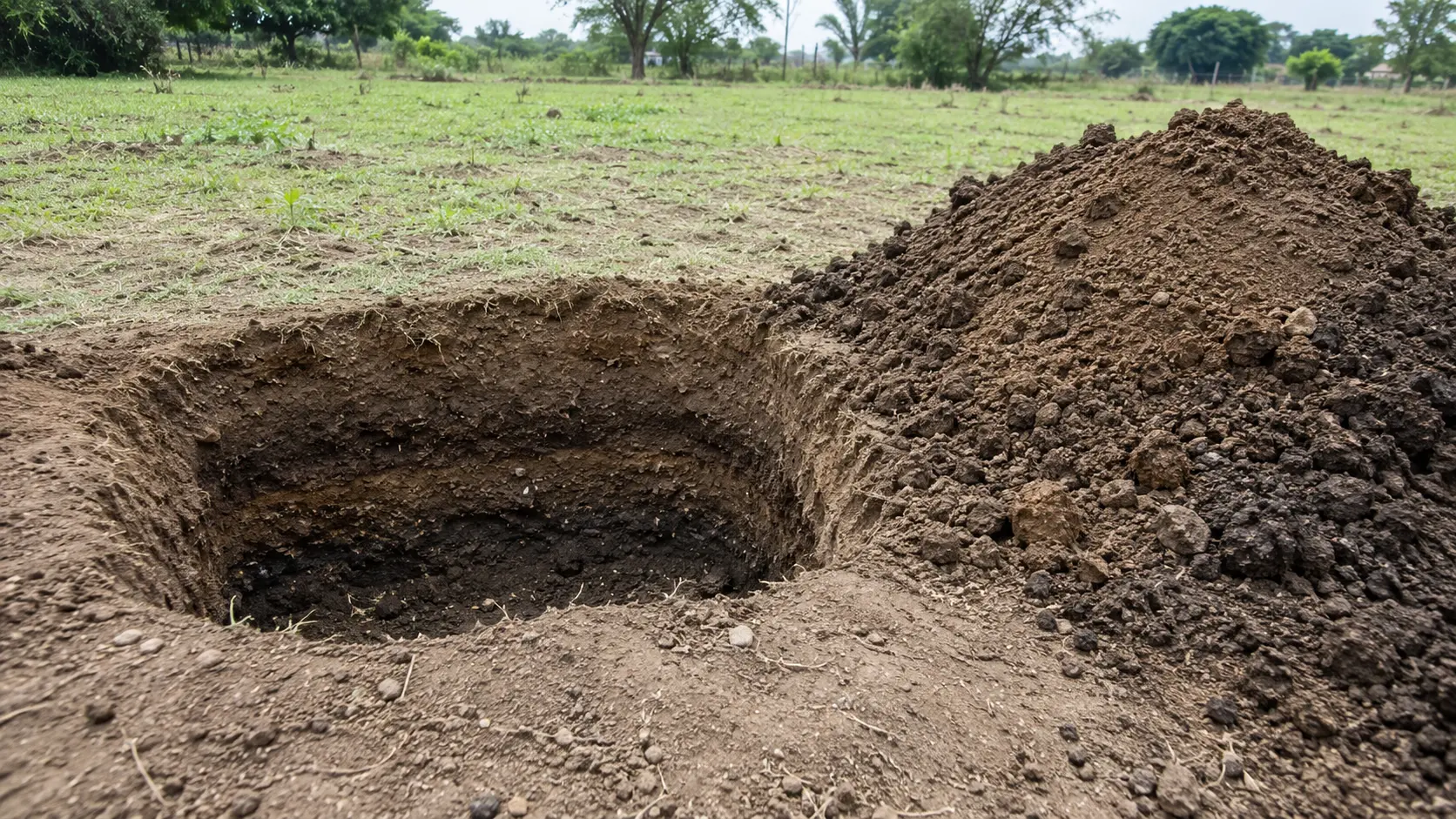
2. Gaddha Pariksha, the pit and refill test
Dig a pit of roughly one cubic hasta, about 45 to 50 cm on each side. Refill it with the same excavated soil, without compacting it.
- Soil left over after refilling means dense, well-graded ground. Favourable.
- Soil exactly filling the pit means average ground. Acceptable.
- Soil falling short means loose, low-density or previously disturbed ground. A warning sign.
This is a crude bulking and density check, and it works. It will not tell you the safe bearing capacity in kilonewtons per square metre, but it will tell you within ten minutes whether the plot you are standing on has been filled recently.
3. Jala Pariksha, the water retention test
Fill the same pit with water and observe. Water that drains almost instantly suggests very porous ground with poor cohesion. Water that stands for a long time suggests heavy clay with poor drainage. The tradition prefers the middle behaviour.
On the Malwa plateau this test is unusually informative, and we will come to why in the next section.
4. Ankur Pariksha, the seed germination test
Seeds are sown in the plot soil and observed for a few days. Vigorous, even germination indicates living, aerated, chemically balanced soil. Poor or patchy germination suggests contamination, salinity, or dead compacted ground.
An old industrial plot in the Pithampur or Govindpura belt will often fail this test visibly, and that failure is worth taking seriously before a residence goes up on it.
5. Varna, Gandha and Sparsha, the sensory checks
Colour, smell and texture. The texts read soil condition through the senses because there was no other instrument. A sour or chemical smell in the excavated soil, unusual staining, or an oily surface film are all reasons to stop and get a laboratory test rather than reach for a remedy. Old effluent contamination does not respond to Vastu correction. It responds to soil replacement or, more often, to walking away from the deal.
6. Plot shape, slope and surroundings
The traditional preferences are for regular rectangular or square plots, ground sloping toward the north and east, and higher ground to the south and west. Sites with sharp cuts, extreme irregularity, or a steep slope toward the south west are treated as difficult.
Part of this is prescriptive tradition. Part of it is drainage and stability logic that any civil engineer would recognise, because water moving toward the low corner of a plot has to go somewhere, and that somewhere is usually against a foundation wall.
Why This Matters Specifically in Indore, Ujjain and Bhopal
Here is where the local ground conditions turn a traditional practice into a practical necessity.
Indore, Ujjain, Dewas and much of Bhopal sit on the Malwa plateau, whose bedrock is Deccan Trap basalt. The weathering of that basalt is what produces the black soil that dominates the region, and black soil covers close to 47.6 percent of Madhya Pradesh's land area, including Indore, Ujjain, Dewas, Bhopal, Sehore, Raisen, Vidisha and Shajapur districts.
Black cotton soil is the everyday name for what geotechnical engineers call expansive soil, and its behaviour is the reason so many houses in this belt develop cracks on a predictable schedule.
The soil is rich in montmorillonite clay, which absorbs water and swells during the monsoon, then shrinks and hardens in the dry season. The volume change can reach 20 to 30 percent of the original volume, and the upward pressure generated is high enough to lift a foundation, producing wall cracks that are narrow at the base and widen as they rise. The same shrink and swell cycle opens tension cracks that remove support from under footings, and in some cases the shrinking soil clings to the footing and drags it down, producing horizontal cracks in walls.
Three practical consequences follow for anyone buying a plot in this region:
- 01Seasonal timing distorts your site inspection. The same plot inspected in May and in August behaves like two different sites. Hard, fissured and stone-like in summer. Sticky, swollen and soft in the monsoon. A single visit in one season tells you very little.
- 02The depth of the black soil layer matters more than its presence. Nearly every plot in Indore and Ujjain has some. What decides your foundation cost is how many metres of it sit between the surface and weathered basalt below.
- 03Foundation design is not optional. Standard shallow footings on untreated expansive soil are exactly how the cracking cases we described at the start begin. Under-reamed piles, deeper footings taken below the active moisture zone, soil replacement with murrum, or a designed cushion layer are engineering decisions, and they must be priced into the plot before you buy, not discovered afterwards.
Northern Bhopal introduces a further variation, with Vindhyan sandstone formations giving very different ground behaviour from one locality to the next. Two plots on opposite sides of the same road can genuinely require different foundations. Ujjain adds the Shipra floodplain, where low-lying pockets carry a water table and seasonal flooding history that no traditional test will reveal and no seller will volunteer.
The Modern Half of Bhoomi Parikshan
Traditional Bhoomi Parikshan gives you a fast, cheap, useful first screen. It does not give you numbers, and numbers are what your structural engineer needs.
For any plot where you intend to build, arrange a geotechnical investigation before the sale deed, not after:
| Test | What it tells you |
|---|---|
| Borehole or trial pit log | Depth of black cotton soil and the level of weathered rock below |
| Safe bearing capacity | The load the ground can carry, which drives foundation type and cost |
| Free swell index and plasticity index | How severely the soil expands, and therefore how much treatment it needs |
| Atterberg limits and moisture content | Seasonal behaviour of the clay fraction |
| Water table depth | Basement feasibility, waterproofing requirement, uplift risk |
| Chemical analysis, sulphates and chlorides | Whether ordinary cement will be attacked over time |
A basic residential plot investigation is inexpensive compared with the cost of remedying a failed foundation, and infinitely cheaper than the litigation that follows a builder dispute.
Documents Are Part of Land Testing Too
An excellent plot with defective title is still a bad purchase. Before payment, verify the following independently rather than relying on the seller's file:
- 01Khasra, Khatauni and Bhu Naksha through the state's official land records portal at MP Bhulekh, which is the Revenue Department's own system for ownership, plot boundaries and mutation status. Insist on a digitally signed copy, not a photocopy.
- 02Diversion status. Agricultural land converted for residential or commercial use requires proper diversion under the MP Land Revenue Code. Undiverted land on the outskirts of Indore and Bhopal is sold to unwary buyers constantly.
- 03Layout approval from the relevant development authority or Town and Country Planning office, plus municipal approval where applicable.
- 04RERA registration for any project that requires it, verified on the Madhya Pradesh RERA portal by registration number rather than by the brochure.
- 05Encumbrance and litigation check through the sub-registrar's records and a property lawyer. Not through the broker.
- 06Physical boundary verification against the Bhu Naksha map, on site, with a surveyor. Boundary shortfall on paper versus ground is one of the most common disputes in peripheral layouts.
A Practical Checklist Before You Pay the Token Amount
- Visit the plot at least twice, ideally once during monsoon
- Ask directly what was previously on the land, then verify the answer with neighbours rather than the seller
- Dig a test pit and run the refill and water tests yourself, in under an hour
- Look at the age and condition of existing buildings on adjoining plots, especially their plinth cracks
- Check the direction of natural slope and where rainwater currently collects
- Note overhead electrical lines, nallahs, transformer positions, and low-lying pockets
- Commission a soil investigation before the deed, and make the sale conditional on it if you can
- Verify title and diversion independently
- Only then bring in Vastu analysis for orientation, entrance direction and internal layout
Notice the order. Ground first, documents second, orientation third. A Vastu report on a plot with three metres of untested expansive clay and a defective title is a decorative exercise.
Where Vastu Advice Genuinely Adds Value
Once the land is sound and the title is clean, plot-level Vastu decisions have real practical weight, because most of them are irreversible after construction begins:
- Placement and direction of the main entrance
- Orientation of the building block within the plot boundary
- Positioning of the water source, underground tank and septic arrangement
- Location of the kitchen, master bedroom and pooja space
- Which corner carries the load of the staircase and which stays open
- Levelling decisions and where the ground is raised or cut
These are drawing-board decisions. Fixing them later costs demolition. That is why a site consultation before finalising the plan is worth more than any correction afterwards, and why we usually decline to issue remedies for a completed structure when the underlying problem is a foundation on untreated soil. It would be dishonest to take the fee.
Frequently Asked Questions
Is Bhoomi Parikshan in Vastu the same as a soil test?
Can Vastu remedies fix a plot with bad soil?
Is black cotton soil in Indore, Ujjain and Bhopal a reason not to buy?
When should I do a land inspection, before or after booking?
Does an apartment buyer need any of this?
Before You Sign, Get the Ground Checked
Land is the one decision in a building project that cannot be revised later. Everything else, from the layout to the finishes to the paint, can be changed. The plot cannot.
Devagya Sutram provides site visits for plot and property evaluation across Indore, Ujjain, Bhopal, Dewas and Pithampur, covering traditional Bhoomi Parikshan, orientation and layout guidance, and a clear statement of where you need a structural engineer or a property lawyer rather than an advisor. Where the buyer wants it, the site reading is combined with a Vedic astrology consultation on the timing of the purchase.
Considering a plot? Call +91 94796 90735 or request a site visit through our contact page. Consultant: Rohit Karla.
This article is general guidance. Soil investigation, structural design and title verification must be carried out by a qualified geotechnical engineer, structural engineer and property lawyer respectively.
Considering a plot?
Site visits for plot and property evaluation across Indore, Ujjain, Bhopal, Dewas and Pithampur, covering traditional Bhoomi Parikshan alongside orientation and layout guidance.
Initiate a Consultation