Ask ten people in Indore what Rahu and Ketu are, and most will give you some version of the same answer: two bad planets that ruin things. Some will mention a snake. A few will mention an eclipse. Almost nobody will tell you the actual answer, which is that Rahu and Ketu are not planets, do not exist as objects, and cannot be photographed by any telescope on earth.
That is not a technicality. It changes how you should think about them.
This page explains what the shadow planets really are, how they move, and which popular terms attached to them mean what. It does not tell you what Rahu or Ketu are doing in your chart. That answer depends on your birth details and belongs in a consultation, not on a web page.
What Are Rahu and Ketu in Vedic Astrology?
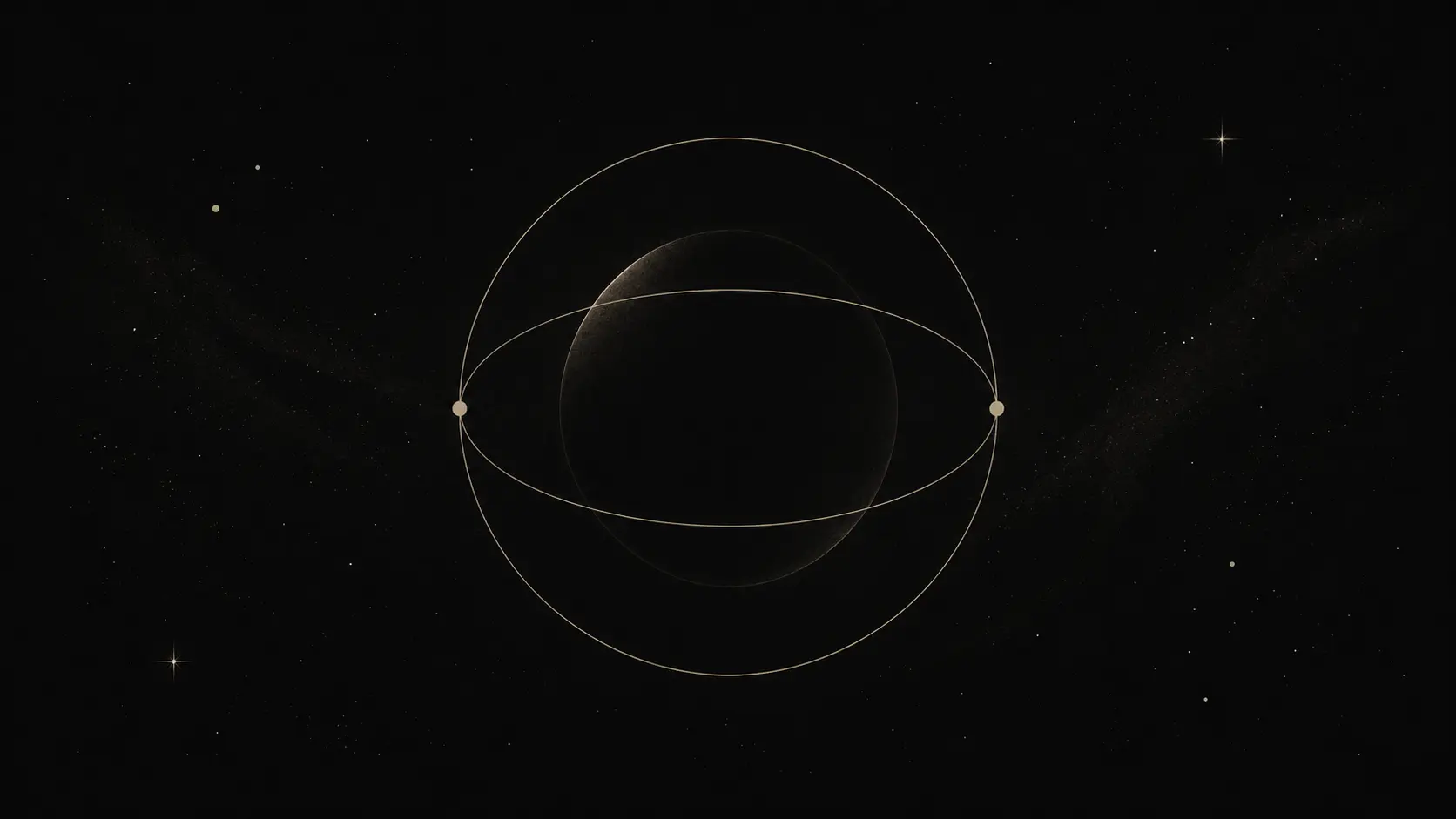
Rahu and Ketu are not physical bodies. They are the two points in the sky where the Moon's path crosses the Sun's apparent path, which is why Indian astrology calls them chhaya grahas, or shadow planets.
Here is the picture. The Sun appears to trace one fixed line across the sky over a year. Astronomers call that line the ecliptic. The Moon travels its own path around the earth, but that path is tilted by roughly 5 degrees, so it does not sit flat on the same line.
Two tilted circles that share a centre will always cross at exactly two points.
Those two crossing points are the nodes. The one where the Moon climbs above the Sun's path is the north node, which Indian astrology calls Rahu. The one where the Moon drops below it is the south node, which is Ketu. In a kundli they get symbols, degrees and house positions just like Mars or Venus, but there is nothing there. No rock, no gas, no light.
Rahu and Ketu Always Sit Opposite Each Other
Because the two crossing points sit on opposite sides of a circle, Rahu and Ketu are always exactly 180 degrees apart. Always. In every chart ever cast, for every person born anywhere.
This is why experienced practitioners treat them as one axis rather than two separate placements. You cannot move one without moving the other. If someone tells you Rahu is in your fifth house, they have already told you where Ketu is, whether they said so or not.
| Feature | Rahu | Ketu |
|---|---|---|
| Astronomical name | North node, ascending node | South node, descending node |
| Physical body | None, it is a calculated point | None, it is a calculated point |
| Distance from the other node | Always 180 degrees | Always 180 degrees |
| Direction of movement | Backwards through the zodiac | Backwards through the zodiac |
| Time spent in one sign | About 18 months | About 18 months |
| Full circle of the zodiac | About 18.6 years | About 18.6 years |
| Length in the Vimshottari dasha cycle | 18 years | 7 years |
Why Are Rahu and Ketu Called Shadow Planets?
The name comes from eclipses. Chhaya means shadow, and the two nodes are the only places where an eclipse can happen, so the tradition named them after the shadow itself.
An eclipse needs the Sun, the earth and the Moon in a straight line. That lineup can only happen when the Moon is near one of the crossing points, because everywhere else on its path it passes above or below the Sun's line and simply misses. NASA's explainer on why eclipses do not happen every month covers the same geometry in plain language, and its eclipse catalogue lists every solar and lunar eclipse across thousands of years. Every single date in that catalogue falls near a node.
So the ancient naming was not decorative. It was accurate.
The story most families know is the one from the churning of the ocean. An asura slips into the line of gods, drinks the nectar of immortality, and is beheaded before it reaches his throat. The head lives on as Rahu, the body as Ketu, and the pair chase the Sun and Moon across the sky in revenge, swallowing them from time to time. Different Puranic sources tell it with different details.
Read it as a memory device and it makes complete sense. The story is describing eclipses at the nodes, in a form a village could pass down for two thousand years without a single calculation.
How Fast Do Rahu and Ketu Move Through a Birth Chart?
The nodes move backwards through the zodiac at a steady pace, covering all twelve signs in roughly 18.6 years and spending about 18 months in each sign. That backward motion is normal for them, not a special condition.
Compare this with the Moon, which changes sign every two and a quarter days. Or Saturn, which takes about two and a half years per sign. The nodes sit in the slow group, which is why their sign changes are discussed publicly and why every astrology channel makes a video when they shift.
In the Vimshottari dasha system, the 120 year cycle used across most of India, Rahu holds the longest single stretch at 18 years and Ketu holds one of the shortest at 7 years. Those numbers are fixed. What a given stretch means for a given person is not fixed, and no honest practitioner will tell you otherwise without seeing the whole chart.
Mean Node and True Node
If you have generated a kundli on two different apps and found Rahu at slightly different degrees, this is usually why.
The crossing points wobble slightly as they move. Software can either report the smoothed average position, called the mean node, or the exact wobbling position, called the true node. Most classical Indian practice and most Indian software use the mean node. Western software often defaults to the true node.
The gap is usually well under two degrees. It rarely changes the sign, but near a sign boundary it can, and that is worth checking before anyone reads anything into it.
What Kaal Sarp Yoga Actually Refers To
Kaal Sarp Yoga is the name given to a chart pattern in which all seven of the traditional planets fall on one side of the Rahu and Ketu axis, leaving the other half of the chart empty.
That is the definition. That is all it is, geometrically.
What you will find online is very different: fear-based lists, cancellation conditions, scoring rules, and a puja in Ujjain that supposedly settles it. We will not publish any of that here, and the reason is practical rather than modest. Whether a pattern like this matters at all in a specific chart depends on which planets sit where, how strong they are, which dasha is running, and what the person is actually dealing with. A checklist published for strangers cannot weigh any of that. It can only produce a verdict that sounds confident and is unearned.
If a previous astrologer named this pattern in your chart and left you worried, bring the reading itself to a Vedic astrology consultation in Indore and we will go through what was said and what the chart actually supports.
Rahu Kaal Is Not the Same Thing at All
This one causes real confusion, so it is worth separating clearly.
Rahu Kaal is a time band in the daily panchang. The stretch between sunrise and sunset is divided into eight equal parts, and one of those parts is assigned to Rahu, with the assignment changing by weekday. It is traditionally treated as an unfavourable window for beginning something new.
It has nothing to do with where Rahu sits in your birth chart. It is the same window for everyone in a city on a given day, whether they are two years old or eighty. Your birth details do not enter the calculation anywhere.
| Term | What it actually refers to | Comes from your birth chart? |
|---|---|---|
| Rahu and Ketu | The two points where the Moon's path crosses the Sun's path | Yes, their position is calculated for your birth moment |
| Rahu Kaal | A daily time band in the panchang, set by weekday and local sunrise | No, it is the same for everyone in your city that day |
| Kaal Sarp Yoga | A pattern where all seven traditional planets fall on one side of the nodal axis | Yes, it is a feature of the chart layout |
| Eclipse | An actual astronomical event, only possible near the nodes | No, it is a sky event visible to whole regions |
| Mean node and true node | Two ways of reporting the same point, smoothed or exact | Yes, it is a calculation setting in the software |
What the Shadow Planets Cannot Tell You
Being clear about limits is not a weakness in this work. It is the part most readings skip.
- They cannot predict a specific event on a specific date. Nothing in the nodal position produces an accident, a job loss, or a wedding date. Anyone claiming that precision is selling certainty they do not have.
- They are not a medical opinion. Symptoms belong with a doctor. A chart reading does not diagnose, does not confirm a diagnosis, and does not replace treatment already prescribed.
- They do not carry a physical force. The nodes have no mass and no light, so there is no gravitational or radiation effect to point at. Vedic astrology treats them as significant reference points within its own framework, and that framework is traditional practice, not measured physics. Anyone who tells you otherwise is overselling.
- They are read differently by different schools. Some traditions assign Rahu and Ketu rulership over certain signs. Others hold that shadow points cannot own a sign at all. Western astrology reads the same two points but frames them quite differently. There is no single settled position, in India or abroad.
- They cannot be read in isolation. The nodal axis interacts with the lagna, the Moon, the running dasha and the current transits. Pull it out of that context and you are reading one line from a page.
What Clients in Indore Usually Ask About Rahu and Ketu
Most people who bring this subject to a consultation are not curious. They are worried, and usually because someone else made them worried.
The pattern repeats. Someone visits an astrologer near their neighbourhood, hears the words Rahu, Kaal Sarp or nodal dasha, is quoted a figure for a remedy, and leaves more anxious than they arrived. Then they come here wanting a second opinion.
That second look is a straightforward piece of work. It involves recalculating the chart from your exact birth details, checking whether the pattern named is even present at the mean node setting, seeing what else is happening in the chart, and telling you plainly what is supported and what was decoration. Sometimes the earlier reading holds up. Sometimes it does not survive the recalculation.
Either way, you leave with a clear picture rather than a vague warning.
Frequently Asked Questions
Are Rahu and Ketu real planets?
Is Rahu always bad and Ketu always spiritual?
Why do two astrology apps show Rahu at different degrees?
Does an eclipse affect me personally because of Rahu and Ketu?
Can I check my own chart for Kaal Sarp Yoga using an online tool?
Should I do a remedy for Rahu or Ketu?
Getting a Straight Answer on Your Own Chart
The shadow planets get more fear attached to them than any other part of a kundli, and most of that fear is manufactured by people with something to sell. The astronomy underneath is calm and completely understandable. The reading of it is careful work that needs your actual birth details.
If you want your chart looked at properly, including anything about Rahu and Ketu that has been said to you elsewhere, Rohit Karla takes consultations in person for clients in Indore, Ujjain, Dewas and Bhopal, and by scheduled phone call for everyone else, including families abroad. You can book a consultation here or read more about how a Vedic astrology consultation in Indore works before deciding.
Astrological guidance is advisory. It does not replace medical, legal or financial counsel from a licensed professional.
Been told something about Rahu or Ketu?
Bring the reading itself. We will recalculate the chart from your birth details and tell you plainly what is supported and what was decoration.
Initiate a Consultation