A family in Indore came to us last year with a proposal they had already decided to refuse. The horoscopes had been matched elsewhere. The score was 24 out of 36, comfortably above the usual threshold, but Nadi had scored zero and the pandit had said the words that end most conversations: Nadi Dosha.
We rechecked the charts. Both moon nakshatras did fall in the same Nadi. But they were different nakshatras, the rashi lords were friendly, and the classical texts themselves list that combination among the recognised exceptions.
The match went ahead.
This is the most consequential single line in Guna Milan, and it is also the one most often applied without the conditions attached to it. So let us take it apart properly.
What is Nadi in Vedic Matchmaking?
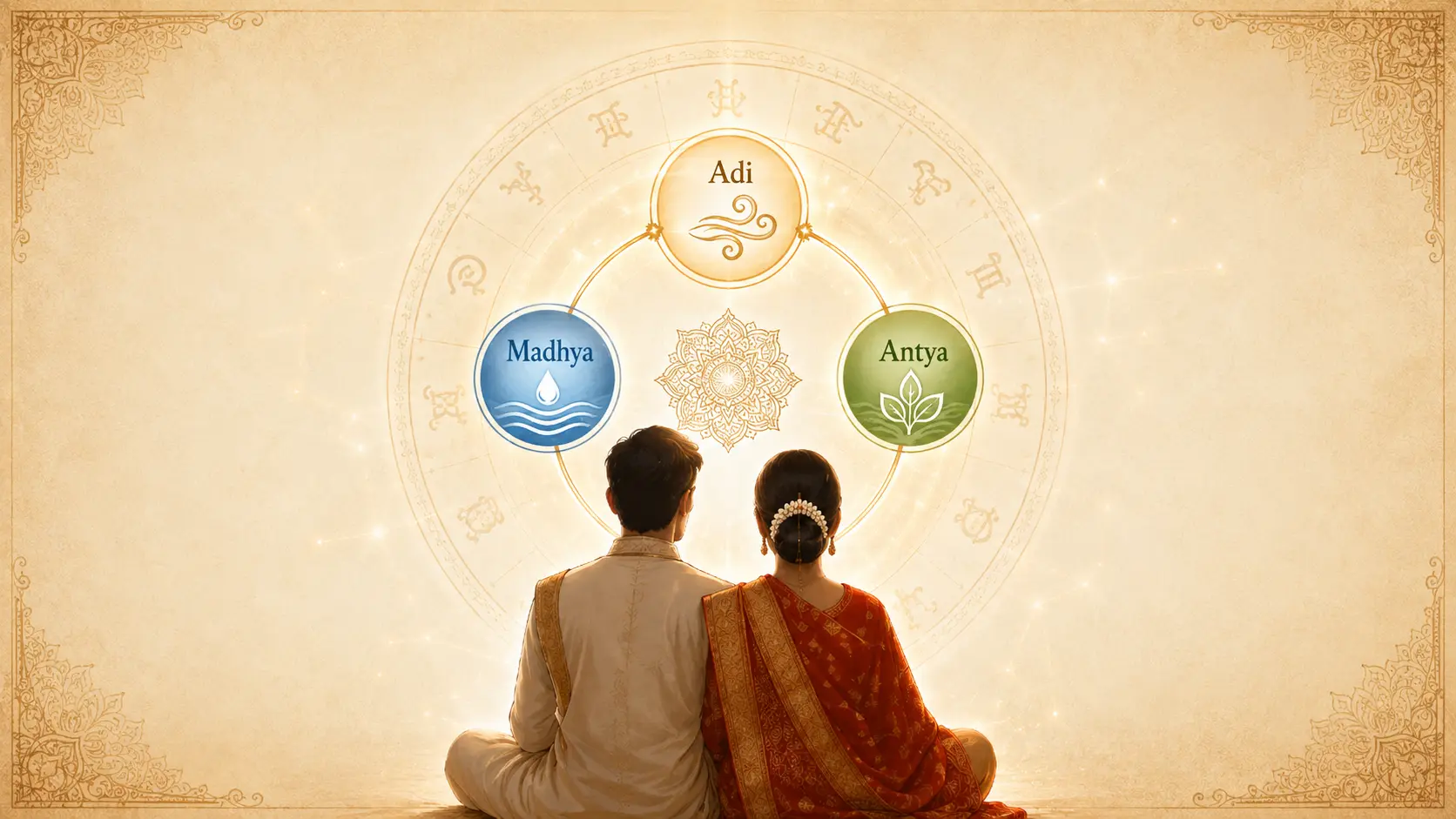
Nadi is one of the eight kootas of Ashtakoota matching, and it classifies each person into one of three constitutional types based on their moon nakshatra at birth: Adi, Madhya or Antya. It carries 8 points, the highest weight of any single koota in the 36-point Guna Milan system, and traditionally relates to health, vitality and progeny.
The word nadi means channel or flow. The three Nadis map onto the Ayurvedic doshas of Vata, Pitta and Kapha, which is the clue to what the classification was originally reaching for. It is a constitutional category, not a personality one.
Where Nadi differs from every other koota is in how it scores. There is no partial credit. Two people either fall in different Nadis and receive the full 8 points, or they fall in the same Nadi and receive zero.
How Nadi Fits Into the 36 Points of Guna Milan
| Koota and points | What it traditionally assesses |
|---|---|
| Varna · 1 | Temperamental and work orientation |
| Vashya · 2 | Mutual influence and control |
| Tara · 3 | Health, fortune and general wellbeing |
| Yoni · 4 | Physical and intimate compatibility |
| Graha Maitri · 5 | Mental affinity through the moon sign lords |
| Gana · 6 | Behavioural nature and disposition |
| Bhakoot · 7 | Emotional harmony and family prosperity |
| Nadi · 8 | Constitution, health and progeny |
| Total · 36 | The complete Ashtakoota score |
Look at the arithmetic. Nadi and Bhakoot together account for 15 of the 36 points. Since most families in Indore and across Madhya Pradesh work with a minimum of 18, a zero in Nadi means the remaining seven kootas must deliver 18 out of 28 for the match to clear the bar at all. A single missing Nadi score is therefore enough to sink an otherwise excellent match.
That is precisely why it deserves more scrutiny than a one-word verdict.
The Three Nadis and Their Nakshatras
Your Nadi is fixed by the nakshatra occupied by the moon at your birth. Nothing else.
| Nadi and Ayurvedic type | Nakshatras |
|---|---|
| Adi (Vata) · Air | Ashwini, Ardra, Punarvasu, Uttara Phalguni, Hasta, Jyeshtha, Moola, Shatabhisha, Purva Bhadrapada |
| Madhya (Pitta) · Fire | Bharani, Mrigashira, Pushya, Purva Phalguni, Chitra, Anuradha, Purva Ashadha, Dhanishta, Uttara Bhadrapada |
| Antya (Kapha) · Water | Krittika, Rohini, Ashlesha, Magha, Swati, Vishakha, Uttara Ashadha, Shravana, Revati |
Nine nakshatras in each group, distributed in a fixed pattern across the 27. Note that adjacent nakshatras usually belong to different Nadis, which is why a birth time error of even an hour or two can flip the result entirely on a fast-moving moon.
This is not a small point. The moon covers one nakshatra in roughly 24 hours, and near a boundary a difference of minutes changes the Nadi, changes 8 points, and changes the family's decision. Any Nadi verdict built on an approximate birth time should be treated as provisional until the time is confirmed or rectified.
What is Nadi Dosha?
Nadi Dosha, also called Nadi Mahadosha, occurs when both prospective partners fall in the same Nadi. Same Nadi means zero out of 8.
The classical reasoning runs like this: identical constitutional types intensify rather than balance each other, and the tradition connects that imbalance to health difficulties and to the wellbeing of children. Adi and Adi is generally treated as the most severe pairing, then Antya with Antya, then Madhya with Madhya.
Two things are worth stating plainly here.
First, this is a traditional health-and-progeny inference, not a clinical one. It cannot detect any actual genetic risk, and we deal with that gap in a dedicated section below because it matters more than the koota does.
Second, and this is the part routinely omitted: the same classical tradition that defines Nadi Dosha also defines the conditions under which it does not apply.
When Nadi Dosha Is Cancelled
Nadi Dosha Parihar, the cancellation of the dosha, is recognised in the classical literature under several conditions. The commonly accepted ones are these:
- 01Same nakshatra, different pada. Both partners born in the same nakshatra but in different quarters of it.
- 02Same Nadi, different nakshatras. The most frequently encountered exception, and the one that resolved the Indore case at the top of this article.
- 03Same nakshatra, different rashi, or the reverse, same rashi with different nakshatras.
- 04Strong Graha Maitri. When the moon sign lords of both charts are friends, or are the same planet, the constitutional objection loses much of its force.
- 05Same rashi lord for both charts.
A competent matchmaker checks every one of these before pronouncing a dosha. In practice, a meaningful share of the Nadi Dosha verdicts families bring to us fall under exception 2 or exception 4 and were simply never examined.
The reverse is also true, and it deserves equal weight. Cancellation is not automatic and should not be manufactured to please a family that has already made up its mind. If none of the conditions apply, the honest answer is that the dosha stands, and the decision then belongs to the couple and their families with that fact on the table.
Why Nadi Alone Should Never Decide a Marriage
Here is where we depart from the way Guna Milan is commonly used.
The 36-point score is a first-pass filter. It is calculated entirely from two moon nakshatras. It ignores the lagna, every planetary position, every yoga, and the dasha sequence both people are running. A pair of charts can score 32 out of 36 and still carry a badly afflicted seventh house, a Mangal placement that has gone unchecked, or dasha periods that pull the two lives in opposite directions for the next twelve years.
A full compatibility reading examines, at minimum:
- The seventh house, its lord, and its condition in both charts
- Mangal Dosha in both charts, and whether it is mutually cancelled
- Navamsa (D9) comparison, which speaks to marriage more directly than the D1
- Venus and Jupiter placements, for the husband's and wife's chart respectively
- Dasha overlap, meaning what each person is running during the proposed marriage years and for the decade after
- Longevity and health indications in both charts, read with caution and without alarmism
We have seen matches at 30 points that we could not recommend, and matches at 16 points that we could. The number is a starting point in a conversation, not a verdict.
The Question Nadi Cannot Answer
Since Nadi is traditionally linked to progeny and the health of children, this needs saying clearly.
Nadi Koota cannot detect genetic risk. It is calculated from the moon's position. It knows nothing about either family's carrier status for inherited blood disorders, and no arrangement of nakshatras will change that.
This is not an abstract concern in Madhya Pradesh. Sickle cell disease is concentrated in the tribal populations of Madhya Pradesh, Chhattisgarh, Odisha, Maharashtra, Gujarat and Jharkhand, with over 20 million people in these regions estimated to carry the trait. The National Sickle Cell Anaemia Elimination Mission, launched in July 2023 from Shahdol in Madhya Pradesh, is built on three pillars, one of which is pre-marital genetic counselling, and it screens through validated point-of-care testing kits at the community level. Madhya Pradesh is among the states reporting the highest number of diagnosed cases. Thalassemia carrier screening carries the same logic.
So our standing advice to every family that comes for matchmaking is this: run the koota analysis, read the full charts, and get both prospective partners screened through the government sickle cell mission or a pathology laboratory. A carrier-to-carrier match is a real, measurable risk with real counselling options. Two people sharing a Nadi is a traditional category. Do not confuse the two, and do not let one substitute for the other.
We are astrologers. On this specific question, the pathology report outranks the kundli, and any practitioner who tells you otherwise is overstepping.
Frequently Asked Questions
Can a marriage happen with Nadi Dosha?
Does Nadi Dosha affect children?
How many points are needed for a match in Guna Milan?
What if both partners have the same nakshatra?
Can Nadi Dosha be removed by a puja or a remedy?
My birth time is approximate. Is the Nadi result reliable?
Get Both Charts Read Properly
If a proposal in your family has been stopped by a Nadi verdict, or cleared by a score that nobody explained, it is worth having both charts examined in full before a decision is finalised.
Devagya Sutram provides horoscope matching covering the complete Ashtakoota analysis, every applicable dosha and its cancellation conditions, Navamsa comparison, and dasha overlap for both partners. The reading is done personally by Rohit Karla, in Hindi or English. See the Vedic astrology consultation page for consultation formats.
Sittings are held in person at the Indore office, and families travel to us from Ujjain, Dewas, Bhopal and the surrounding areas. If you are elsewhere, a scheduled phone consultation carries exactly the same depth, since matching depends on both sets of birth details rather than on where the conversation happens.
Call +91 94796 90735 or request an appointment with both birth details.
Astrological compatibility analysis is advisory. It does not replace medical or genetic counselling, which should be obtained from qualified healthcare professionals.
Stopped by a Nadi verdict?
Have both charts examined in full before the decision is finalised. Send both sets of birth details and we will confirm a slot.
Initiate a Consultation